Most people have heard the word by now. Far fewer have been told what the medicine actually does once it is in the body. It is worth understanding, because the mechanism is simpler than the headlines make it sound, and it explains almost everything, including the results and the side effects.
Step 1: It copies a hormone the body already makes
GLP-1 stands for glucagon-like peptide-1. It is not a foreign chemical. It is a hormone the gut releases on its own every time a meal is eaten. Scientists identified it in the 1980s while studying how the digestive system talks to the rest of the body. In other words, everyone already runs on GLP-1. The medicine simply adds more of the same signal.
Step 2: That hormone has three main jobs
Once GLP-1 is released after a meal, it does three things at once.
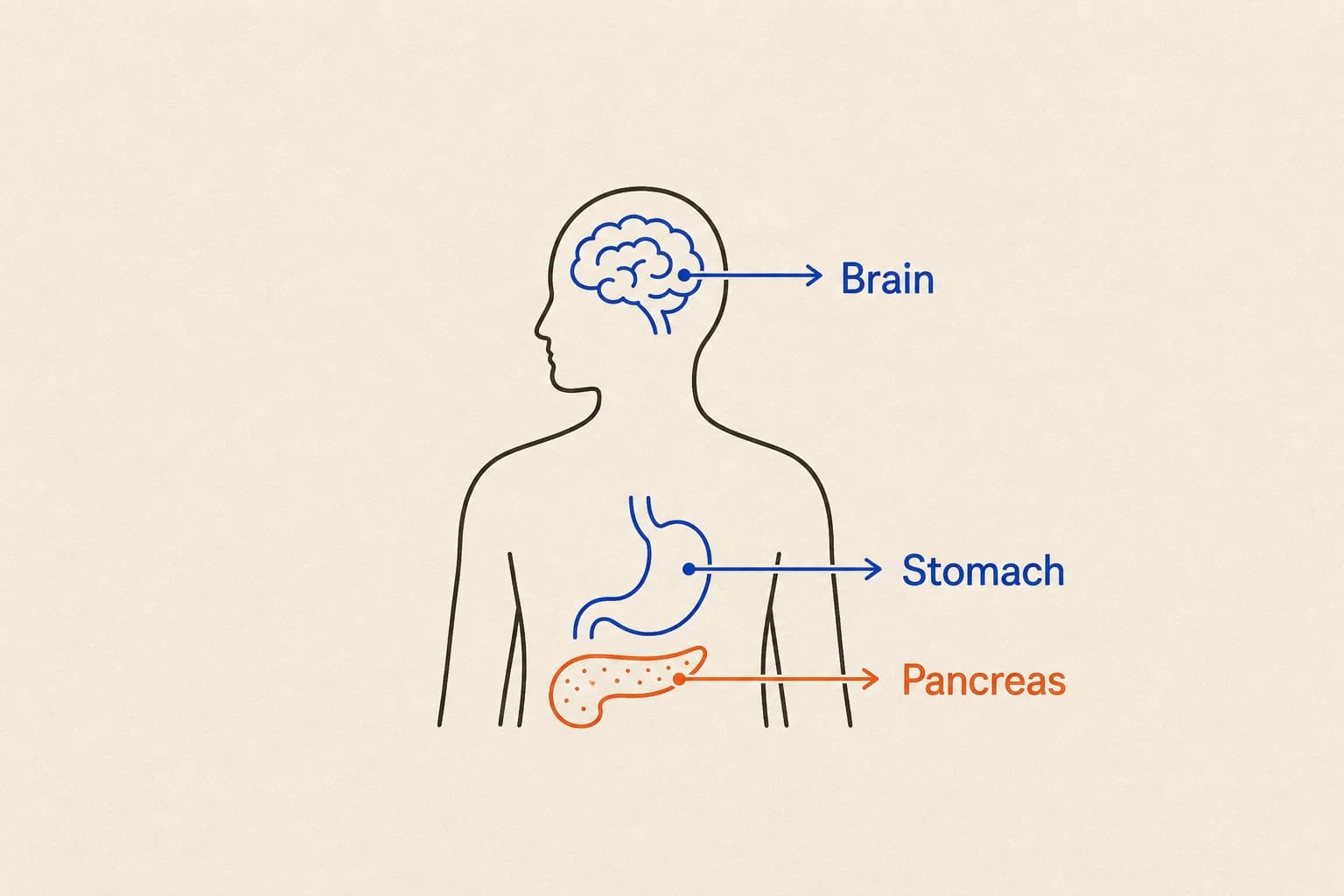
- It tells the brain the body is full. This is the appetite switch. A strong signal means a person stops eating and stops thinking about food.
- It slows how fast the stomach empties. Food stays put a little longer, so fullness lasts longer and hunger takes more time to come back.
- It helps manage blood sugar. It prompts the pancreas to release insulin when blood sugar rises after eating, which keeps levels steadier.
Step 3: The catch is that it disappears in minutes
Here is the problem the body cannot solve on its own. Natural GLP-1 is broken down almost as fast as it is released, within a few minutes. On top of that, in a lot of people the signal is weak to begin with, so the message to stop eating arrives faintly, and the thoughts about food never fully switch off. That constant background hum has a name that researchers and patients now use: food noise.
Step 4: What the medicine changes
Semaglutide is a longer-lasting version of that same GLP-1 signal. It is built to resist the enzyme that normally breaks GLP-1 down, so instead of lasting minutes, it lasts about a week. That is why it is a once-weekly injection. The result is a steady, always-on version of the fullness signal the body was already using, rather than a brief pulse that fades.
Nothing about that is a stimulant or an appetite "blocker." It is the body's own off switch, kept switched on.
Step 5: What that feels like day to day
With the signal turned back up, the effects follow directly from the three jobs above. Appetite settles, so smaller meals feel like enough. The stomach empties more slowly, so fullness lasts and cravings soften. And the food noise, the mental part people find hardest, tends to quiet down. Eating less stops being a daily act of willpower and starts happening more or less on its own.
Step 6: The proof that it adds up
The mechanism is one thing. The results are what large trials measured. In a 68-week study, participants lost on average about 15% of their body weight, next to about 2% on placebo, alongside diet and activity support (STEP 1, NEJM 2021). In people with type 2 diabetes, a similar trial showed both weight loss and improved blood sugar, which fits the insulin part of the mechanism exactly (STEP 2, Lancet 2021). (Study averages. Individual results vary, and these are not Tryozi outcomes.)
Step 7: Why the effects reach past appetite
Because GLP-1 receptors sit in more than just the gut and brain, the medicine has effects across the body. In a trial of more than 17,000 people, semaglutide lowered major cardiovascular events by 20% (SELECT, NEJM 2023), and a dedicated kidney trial was stopped early after it cut major kidney events by 24% (FLOW, NEJM 2024). One honest caveat: those trials used branded semaglutide at set doses in specific patient groups, so they are the science behind the molecule, not a promise for any one person or a claim about compounded products.
Step 8: Why the side effects happen
The mechanism also explains the downsides. Because the medicine slows the stomach, the most common side effects are digestive, especially nausea, and they show up most in the early weeks before the body adjusts. Pooled trial data put nausea and vomiting several times more common than placebo, usually mild to moderate (Kommu meta-analysis, Obes Rev 2024). Semaglutide also carries an FDA boxed warning and is not right for everyone, which is why a clinician reviews a person's health first. And because GLP-1 can affect how quickly the gut moves things along, a clinician should also check it against any other medicines a person takes, though a study of common ones like metformin, warfarin, atorvastatin, and digoxin found no clinically meaningful interference (Hausner, Clin Pharmacokinet 2017).
Step 9: Why it works as ongoing care, not a one-time fix
The last piece of the mechanism is the most misunderstood. The medicine works by supplying the signal. Take it away, and the signal drops back to where it started, so appetite returns and much of the weight tends to come back (STEP 1 Extension, 2022). That is not a flaw. It is the same reason blood-pressure medicine works while it is taken and stops working when it is not. It is designed as ongoing care.
A quick note on getting it safely
Because it is a real medicine, it belongs behind a real clinician. Tryozi offers a clinician-guided path: through its medical partner OpenLoop, a licensed clinician reviews a person's history and prescribes only when it is appropriate. The medicine is compounded semaglutide, made by a licensed U.S. compounding pharmacy. Compounded medicine is not FDA-approved, and Tryozi states that plainly. Pricing is flat and shown up front: $139 for the first month, then $279 per refill, with no automatic renewal at launch.
See if you're a good fit
The mechanism is the same for everyone. Whether it is appropriate is not, and that depends on health history, current medicines, and goals.
The way to find out is a private, two-minute quiz reviewed by a licensed clinician. If it makes sense, the clinician walks through the honest next steps: the side effects, the flat price, and what the plan actually looks like. If it is not the right fit, the answer is a straight no.